

From a student robotics club climbing the international leaderboards to a new interim research chief taking the helm on the Flats, it was a busy day of academics and research news at Georgia Tech. Here is what caught our eye.
Sivakumar Named Interim Executive Vice President for Research
Raghupathy “Siva” Sivakumar has been appointed interim executive vice president for Research, effective Nov. 1. Sivakumar currently serves as Tech’s vice president of Commercialization and chief commercialization officer, and he was the founding director of CREATE-X, the initiative that has helped thousands of students launch real startups. He is also the Wayne J. Holman Chair and a professor in the School of Electrical and Computer Engineering, where he joined the faculty in 2000 and built a research career in wireless networking and mobile computing. An IEEE Fellow with multiple companies of his own to his name, he brings an unusually entrepreneurial resume to the Institute’s top research post. Read the full announcement.
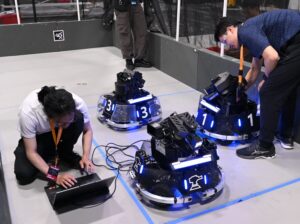
RoboRambler Is Building a Culture of Innovation in Robotics
Two years after it was founded in a dorm room, RoboRambler took second place out of 30 universities worldwide in the 1v1 knockout bracket at the 2026 ARC Championship, plus a top-10 finish in the 3v3 challenge. The team’s combat robots — four sides of armor, a turret, a drive chassis, and an FPV control system — trace back to designs by mechanical engineering student Matthew Zhou and computer engineering student Zimeng Chai in 2024. This year the software side added autonomous aiming and navigation while the mechanical side went lighter and stronger with carbon fiber. Zhou gives much of the credit to driver Nathaniel Phelps: a year ago the team sat in 15th place. Now 30 members strong and with a lab space in Tech Square backed by the ECE CORE Lab, the club wants to share that workspace with Tech’s other robotics organizations. Recruitment is open to any student interested in robotics, engineering major or not. Read more about RoboRambler.
How Much Rain Can a Hurricane Make?
Georgia Tech atmospheric scientist Zachary Handlos, who directs the Atmospheric and Oceanic Sciences B.S. program, answered a question from an 8-year-old in Pittsburgh with a tour of hurricane rainfall science. The short version: the headline total matters far less than how much falls in one place. Hurricane Harvey dropped an estimated 27 trillion gallons on Texas in 2017 and more than 60 inches on Nederland because it stalled, while the far more powerful Hurricane Michael left 6 to 10 inches along its path in 2018 because it moved fast. Storm size, he notes, appears tied to how much warmer the ocean is than normal for the season — one reason Helene grew so large in 2024 — and rapid intensification remains one of the field’s most urgent open problems. Read the full explainer.
On the Calendar
- Oct. 27, 12–3 p.m. — Boo-tique: Green Goodbyes Halloween Pop-up at the Kendeda Building. Free costume pieces, clothing, and accessories to dig through, plus a build-your-own trail mix bar.
- Oct. 31, 5–8 p.m. — Trick or Treating in Tech Square. Costumes encouraged (no full face masks in stores), and it runs until the candy runs out.
- Nov. 3, 2–4:15 p.m. — Film Futures: Chris Marker’s Science Fiction and Cinematic Arts in the Scholar’s Event Theatre at Price Gilbert. A panel on La Jetée with professors Stéphanie Boulard, Kristi McKim, Lisa Yaszek, and Ida Yoshinaga, followed by a hands-on creative workshop.
Which of these are you most excited about — the new research leadership, the robots, or a Halloween costume you did not have to buy? Drop a comment and let us know, and check back tomorrow for another round of news from the Flats.
Checkout these Picks
As an Amazon Associate I earn from qualifying purchases.
Discover more from GT Jackets
Subscribe to get the latest posts sent to your email.